

Distinctive product packaging can become a valuable trademark asset. Under trademark law, the overall appearance of packaging may function as trade dress, meaning that consumers recognize the combination of visual features as identifying a particular source.
A recent decision from the U.S. District Court for the Eastern District of New York illustrates both the scope and value of trade dress protection. In Van Leeuwen Ice Cream LLC v. Rebel Creamery LLC, No. 21-CV-2356 (EK)(JRC) (E.D.N.Y. July 16, 2026). After a bench trial, Rebel Creamery was found to have infringed Van Leeuwen’s trade dress in its ice cream pint packaging. The court permanently enjoined Rebel from continuing to use the infringing packaging, required a redesign, and awarded Van Leeuwen $23,785,000 of Rebel’s profits.
What Is Trade Dress?
Trade dress protects the overall design and appearance of a product or its packaging when that appearance identifies the source to consumers. It can include such features as colors, shape, typography, layout, packaging materials, graphics, wording placement and negative space.
The important point is that trade dress is generally considered as a whole. A company does not necessarily need exclusive rights in every individual element. Common colors, fonts or design techniques may still form a protectable trade dress when combined in a distinctive and recognizable way.
That principle was central to the Van Leeuwen decision.
Van Leeuwen’s Claimed Trade Dress
Van Leeuwen identified four elements of its classic dairy pint packaging:
- cardboard monochromatic pints with matching monochromatic lids;
- a primarily pastel color palette;
- black script lettering with an exaggerated capital letter, together with limited descriptive writing in black; and
- an overall minimalist design aesthetic.
The court found that these elements, viewed together, were sufficiently specific to define the claimed trade dress.
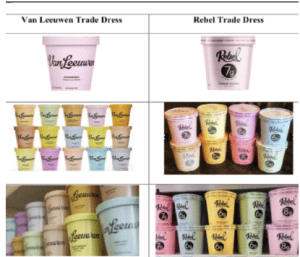
The comparison is particularly instructive because Rebel did not copy the VAN LEEUWEN name. It used the REBEL name. Van Leeuwen’s claim instead focused on the overall visual impression created by Rebel’s pastel monochromatic containers, black cursive lettering and minimalist presentation.
What Makes Trade Dress Protectable?
The decision provides a useful checklist for businesses seeking to protect product packaging.
Specificity
A company cannot simply claim ownership of a generalized “look” or “style.” The trade dress must be described with enough precision that competitors and a court can understand what is claimed.
Judge Komitee found Van Leeuwen’s description sufficiently objective and specific. Importantly, trade dress is evaluated holistically. The court did not require each individual component to be independently protectable.
A Consistent Overall Look
When protection is claimed across a product line, the products must share a recognizable and consistent overall appearance.
Van Leeuwen limited its claim to its classic dairy line. Although some individual flavors departed from the pastel palette, the court concluded that those modest exceptions did not detract from the dominant monochromatic, minimalist look of the line.
For brand owners, this is an important practical point. Consistent packaging can create legal value as well as marketing value.
Distinctiveness
Trade dress must also be distinctive enough to identify source.
Packaging may be inherently distinctive or may acquire distinctiveness through marketplace recognition. The court found Van Leeuwen’s packaging inherently distinctive because its elements reflected arbitrary design choices selected from numerous available alternatives. Ice cream did not have to be sold in pastel monochromatic cardboard containers with black cursive lettering and a minimalist presentation.
Nonfunctionality
Trademark law cannot be used to monopolize features competitors need in order to compete.
The court rejected Rebel’s argument that Van Leeuwen’s minimalist presentation and pastel colors were functional. Other manufacturers could effectively identify and market ice cream without using that combination. The court also noted that although some colors may suggest particular flavors, nothing required those colors to be pastel.
Likelihood of Confusion
Protectable trade dress is only part of an infringement claim. A plaintiff must also establish that the defendant’s packaging is likely to cause consumers to believe mistakenly that the products come from the same source or are otherwise associated.
The court concluded that the applicable legal factors for determining whether consumers were likely to be confused overwhelmingly favored Van Leeuwen. These included the strength of Van Leeuwen’s trade dress, the similarity of the competing packaging, the proximity of the products in the marketplace, evidence of actual consumer confusion, Rebel’s intent in adopting its packaging, and the degree of care consumers were likely to exercise when purchasing the products.
The fact that the packages carried different brand names did not eliminate the risk. Consumers often encounter products quickly in ordinary retail conditions, and ice cream is a relatively inexpensive purchase that may receive only brief attention.
There was also meaningful evidence of actual confusion. Store employees had intermingled the products and applied Rebel price labels to Van Leeuwen pints. A consumer reported that her husband mistakenly purchased Rebel when sent to buy Van Leeuwen because the products were displayed next to one another and looked alike.
Van Leeuwen also introduced survey evidence showing a 34.3% net confusion rate. The court noted that a 15% net confusion rate is generally considered sufficient evidence of actual confusion.
Intent and Independent Development Matter
The court’s findings concerning Rebel’s intent were particularly damaging.
Rebel’s founders testified that they developed their packaging independently and had not seen Van Leeuwen’s packaging. The court did not credit that testimony. Among other things, Rebel had preserved no design iterations, only the final package. In addition, before Rebel’s product reached grocery store shelves, a Wegmans buyer told one of Rebel’s founders that the packaging was similar to Van Leeuwen’s, yet Rebel proceeded without changing it.
The court ultimately found intentional copying and bad faith.
For companies developing new packaging, this underscores the importance of preserving design briefs, drafts, alternative concepts and clearance materials. A documented independent design process may become important evidence if packaging is later challenged.
The $23.785 Million Award
The court did more than order Rebel to redesign its packaging. It also required Rebel to disgorge profits from sales of the infringing pints.
Under the Lanham Act, an award of profits may serve to prevent unjust enrichment and deter infringement. A finding of willfulness is not strictly required, but Rebel’s bad faith strongly supported the remedy.
The parties disputed the amount of profit attributable to the infringing products. Van Leeuwen sought approximately $36.4 million. After resolving disputed costs, the court accepted approximately $35.5 million as the appropriate starting point.
The court nevertheless concluded that Rebel’s commercial success was not attributable solely to its packaging. Evidence showed that the keto and better-for-you market also drove sales. A Rebel market study indicated that 33% of its customers had previously purchased only better-for-you ice creams.
On equitable grounds, the court therefore reduced the profits award by 33%, resulting in an award of $23,785,000.
Key Takeaways
The Van Leeuwen decision offers practical lessons on both sides of the issue.
Brand owners should consider product packaging an intellectual property asset. A strong trade dress position is more likely to develop when a business can clearly identify the recurring visual features of its packaging, uses those features consistently and preserves evidence of marketplace recognition.
When developing new packaging, a business should conduct clearance that goes beyond the proposed name and logo. The combination of color, lettering, layout, negative space and other visual elements should also be considered, particularly when competing products will be sold through the same retail channels.
Businesses should also preserve records showing how packaging was independently developed. Those materials may prove important if similarities with a competitor’s packaging are later challenged.
The central lesson from Van Leeuwen is that a product’s appearance can function as a trademark just as effectively as its name. A different brand name will not necessarily avoid liability if the overall packaging creates a confusingly similar commercial impression. As the $23.785 million award illustrates, the consequences can extend far beyond the cost of redesigning the package.